
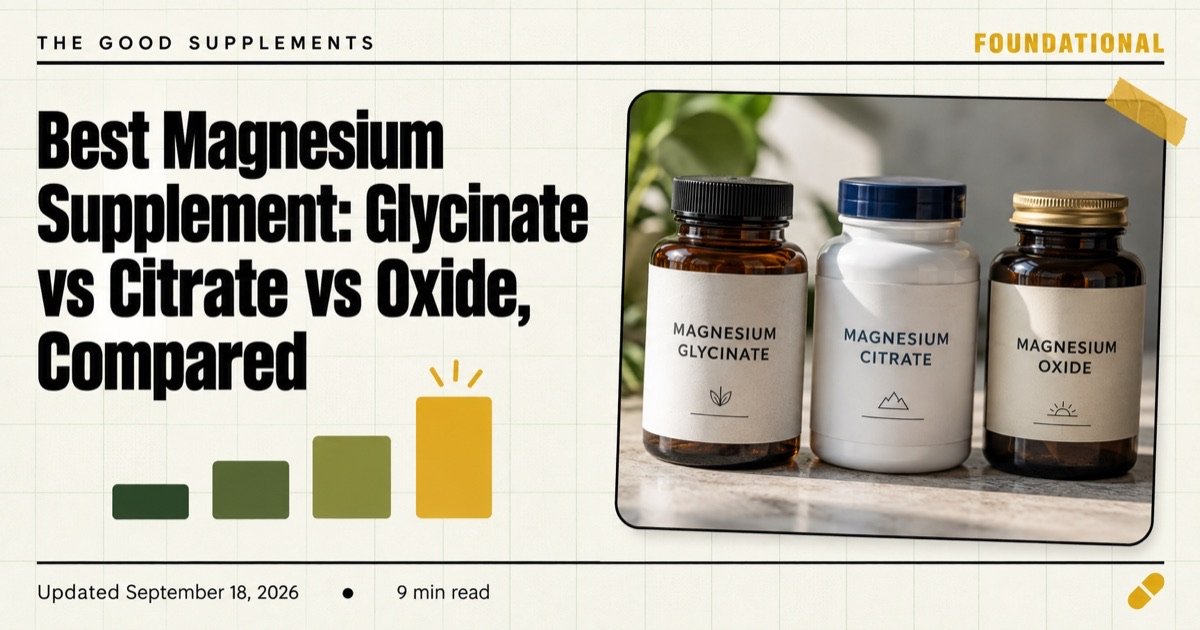
Why "best magnesium supplement" is the wrong question
Searching "best magnesium supplement" mostly surfaces affiliate roundups ranking products by brand reputation. That's the wrong axis.
Magnesium is bonded to a carrier molecule in every supplement: oxide, citrate, glycinate, threonate, malate. The carrier changes absorption, gut tolerance and, in some cases, where in the body the magnesium ends up.
Picking the wrong form for your goal is a bigger mistake than picking a slightly worse brand of the right form. This guide compares the four forms you'll actually find on US shelves and matches each to what it's realistically good for, so the decision is about your goal rather than the marketing copy on the front of a bottle. The site's magnesium glycinate guide covers the trial evidence behind that specific form in more depth.
Magnesium oxide: cheap, poorly absorbed, and mostly a laxative
Magnesium oxide is the form in most store-brand and budget multivitamins. It's cheap to manufacture and has the highest elemental magnesium percentage by weight, roughly 60%.
The problem is absorption. Research consistently puts oxide's bioavailability under 5%. Almost none of that impressive-looking milligram number actually reaches your bloodstream.
Its real clinical use is as a laxative and antacid, which is exactly why products like Phillips' Milk of Magnesia use it. A cheap magnesium supplement listing oxide as the only form won't meaningfully move the needle on sleep, stress or muscle cramps. A large dose is more likely to just cause loose stool.

Magnesium citrate: the reasonable default
Magnesium citrate absorbs considerably better than oxide and costs less than glycinate. That makes it a sensible general-purpose choice if you're correcting a dietary shortfall without a specific sleep or GI concern.
It does carry a mild-to-moderate laxative effect at higher doses, which is why concentrated citrate solutions are used for colonoscopy prep. Most people find their comfortable ceiling somewhere in the 200 to 350mg elemental range before stool changes.
NOW Foods and Nature Made both sell widely available, NSF or USP-marked citrate formulations that are reasonable defaults if cost is the deciding factor and you don't specifically need the gentler GI profile that glycinate offers.
Magnesium glycinate: the sleep and stress pick
Glycinate's advantage is tolerability at a full dose, covered in more depth in the magnesium glycinate dosage guide. Because it's chelated to glycine, it bypasses much of the laxative mechanism that hits citrate and oxide.
That means someone can take 300 to 400mg of elemental magnesium nightly without digestive disruption. It's the better choice for sleep and stress use specifically, where consistency over weeks matters more than a one-time high dose.
It costs more per elemental milligram than citrate or oxide, which is the tradeoff for the better tolerability. Thorne, Pure Encapsulations and Doctor's Best are the three most consistently third-party-tested glycinate brands sold in the US.
| Form | Best for | Elemental % by weight | Laxative effect |
|---|---|---|---|
| Oxide | Occasional constipation | ~60% | Strong |
| Citrate | General deficiency, budget pick | ~16% | Moderate |
| Glycinate | Sleep, stress, daily long-term use | ~14% | Minimal |
| Threonate | Cognitive-focused formulas | ~12% | Minimal |
Magnesium threonate: a narrower, pricier niche
Magnesium L-threonate gets marketed heavily for cognitive support. Animal research suggested it crosses the blood-brain barrier more effectively than other forms, raising brain magnesium levels in ways glycinate or citrate may not.
Human trial data is much thinner than the marketing suggests, and it costs meaningfully more per elemental milligram than any other form here. Fine choice if cognitive support specifically is the goal and budget isn't a constraint. For sleep or general deficiency, glycinate or citrate do the job for less money with a larger evidence base behind the basic deficiency-correction claim.
Other forms you'll see on shelves
Magnesium malate pairs magnesium with malic acid, a compound involved in cellular energy production, and gets marketed toward fatigue and muscle pain, sometimes specifically for fibromyalgia. The absorption is reasonably good, closer to citrate than to oxide, but the trial evidence for the energy-specific claims is thin. Treat it as a citrate alternative rather than a distinct upgrade.
Magnesium chloride, often sold as an oil or spray for topical use, is marketed on the idea that magnesium can be absorbed through skin. The evidence for meaningful transdermal absorption is weak, and oral forms remain the better-supported route for actually raising magnesium status.
Magnesium taurate pairs magnesium with the amino acid taurine and gets marketed for cardiovascular support, since both magnesium and taurine have independent research suggesting heart-related benefits. It's a reasonable niche option if that's specifically your goal, though it's less common and generally pricier than citrate or glycinate.
Cost per elemental milligram, roughly
Because elemental content varies so much by form, comparing sticker price alone is misleading. Oxide is cheapest per elemental milligram by a wide margin, which is exactly why it dominates budget multivitamins despite its poor absorption. Citrate typically runs a moderate premium over oxide. Glycinate usually costs noticeably more per elemental milligram than either, reflecting both the pricier raw chelate and the smaller elemental percentage by weight.
That premium is the price of tolerability, not a sign glycinate is being overpriced for no reason. Whether it's worth paying depends entirely on whether you're taking a dose large enough, and often enough, for the gut-tolerance difference to actually matter to you.
Why so many forms exist in the first place
Elemental magnesium on its own is unstable and needs to be bonded to something else to form a usable, shelf-stable powder. Manufacturers chose different binding compounds over the decades largely for cost and manufacturing reasons first, with absorption and tolerability research following later.
That history is part of why oxide still dominates cheap multivitamins despite better options existing: it was established first and remains the least expensive to produce at scale, not because it's the most effective choice available today.
Reading the label for the actual form
Some labels list simply "magnesium" without specifying the chelate, especially in cheaper multivitamins. That ambiguity is itself informative, since brands using a well-absorbed, more expensive form almost always name it prominently as a selling point.
If the form isn't named anywhere on the label, front or back, assume it's likely oxide, the cheapest default a formulator would reach for without a specific reason to pay more for a better-absorbed alternative. The full evidence grading behind magnesium as a compound, not just this form comparison, is in the site's magnesium glycinate guide, and its place among other sleep-focused options is covered in best supplements for sleep.

What about topical magnesium and Epsom salts?
Epsom salt baths (magnesium sulfate) and magnesium sprays get marketed on the idea of absorbing magnesium through skin. The research supporting meaningful transdermal absorption is thin and largely inconclusive.
A warm Epsom salt bath may still help relaxation and sore muscles simply through warm water and rest, independent of whatever magnesium does or doesn't cross the skin barrier. Treat it as a nice-to-have, not a substitute for an oral form if correcting an actual deficiency is the goal.
How to actually decide
Match the form to the goal, not the other way around. Trying to sleep better or manage stress, and planning to take it nightly for months? Glycinate's tolerability makes it worth the extra cost.
Just closing a general dietary gap and cost matters more? Citrate is the sensible default. Dealing with occasional constipation? Oxide, or citrate at a higher dose, is doing exactly what it's meant to do.
Avoid buying oxide expecting a sleep-support outcome. That mismatch between form and goal is what no amount of brand reputation fixes.