

What you are actually replacing
Oura sells two things: a ring, and a membership that turns the ring's data into readiness, sleep and activity insights. On 18 November 2026 the Ring 4 was $244.30 against $349 on ouraring.com, and the US membership was $5.99 a month or $69.99 a year, with the first month free.
Oura's own membership page says the ring and app still work without a membership, but that insights and data become "much more limited". You can still export your data as CSV. Stop paying and the ring keeps recording, with most of the useful layer gone. Battery is quoted at 5 to 8 days depending on size and settings.
There are two reasons to look elsewhere. They lead to different devices.
If the membership is the problem, other rings solve it. If the ring itself is the problem (sizing, gym grip, wedding bands, scratches), a screenless wrist band does the same overnight job.
Disclosure: Hume Health pays us a commission on sales through our links. None of the other brands on this page do. We haven't worn any of these devices; this comparison is built from each brand's specs and prices, published validation studies and owner reports.
The short list
Prices were read from each brand's own US store on 18 November 2026. We left out any number we couldn't load from the brand directly, which is why two rows are thinner than the rest.
| Device | Form | Price | Subscription | Battery (brand claim) | Buy |
|---|---|---|---|---|---|
| Oura Ring 4 (for reference) | Ring | $244.30, list $349 | $5.99/mo or $69.99/yr, effectively needed | 5 to 8 days | |
| Ultrahuman Ring AIR | Ring | $349 | None required; Max add-on $99.99/yr | 4 to 6 days | |
| Samsung Galaxy Ring | Ring | $399.99 | None required | Up to 6 days, 7 on sizes 12 and 13 | |
| RingConn | Ring | Store would not load for us | None required, per RingConn | Not verified | |
| Hume Band 2.0 | Screenless band | $249, list $356 | None required; premium tier optional | Up to 14 days | Shop |
| Whoop | Screenless band | Not verified | Membership required | Not verified | |
| Amazfit Helio Strap | Screenless band | $99.99 | None required | Up to 10 days |
Oura alternatives, checked 18 November 2026 on each brand's US store
Ring alternatives: same finger, different bill
Ultrahuman Ring AIR is the closest like-for-like swap. Ultrahuman lists it at $349 with no recurring fee for the core data, and sells an optional Ultrahuman Max plan ($29.97 for three months or $99.99 a year) that bundles its PowerPlug add-ons. Its own comparison table quotes 4 to 6 days of battery, a little under Oura's claim.
Samsung Galaxy Ring was $399.99 on samsung.com with no sale price showing for the size we checked. Samsung quotes up to 7 days on sizes 12 and 13 and up to 6 days on smaller sizes, and says battery stretches by up to 30% when worn alongside a Galaxy Watch.
It costs the most up front of the rings we could price, and nothing more after that, since no feature is locked behind a plan. Best fit: people already on a Samsung phone.
RingConn markets its rings as subscription free, with a Gen 3, a Gen 2 and an entry-level Gen 2 Air. Its store rate-limited every request we made on 18 November, so we haven't quoted a price or a battery figure. Check ringconn.com directly before comparing.
The catch with every ring is sizing. You need a sizing kit before the real order, the fit changes with temperature and hand swelling, and a loose ring reads worse overnight. That is the main reason people end up on a band instead.
Screenless bands: the same overnight data on your wrist
Hume Health
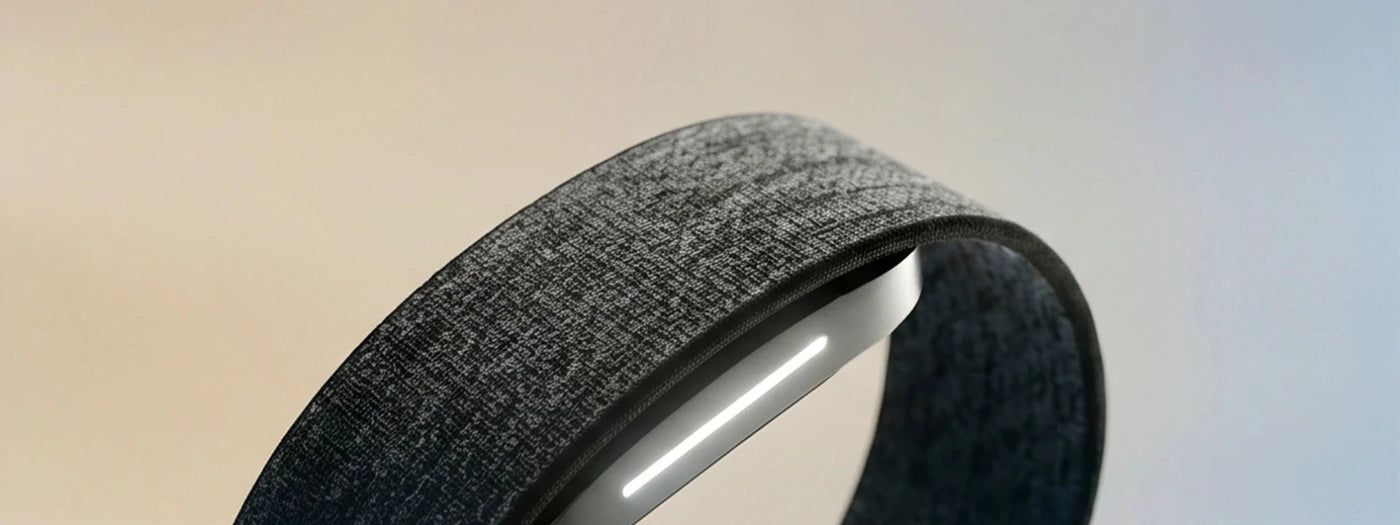
Hume Band 2.0
A screenless band does what a ring does at night: optical heart rate, heart rate variability, skin temperature trends and sleep timing, with no display to charge or glance at. You trade the ring's discretion for a strap that fits everyone and doesn't need sizing.
Hume Band 2.0 was $249 against $356 on humehealth.com on 18 November, part of a Black Friday sale whose countdown says it ends 22 November. Hume quotes up to 14 days of battery, the longest of any device here.
Hume says no subscription is needed for the Band or for your raw data. The free app covers its core metrics; an optional premium tier adds AI coaching. It's HSA/FSA eligible and comes with a 45-day trial. Our Hume Band review sets out what the device does and which claims, notably cuffless blood pressure, still lack independent validation.
Whoop is the band most people think of, and the odd one out for this list. The hardware comes with a paid membership, so leaving Oura for Whoop swaps one subscription for a larger one. Whoop's site blocks automated checks, so we haven't quoted a current price. If you want the details, Hume Band vs Whoop runs the cost comparison out to four years.
Amazfit Helio Strap is the budget option at $99.99, with no required subscription and up to 10 days of battery per Amazfit. It can be worn on the wrist or upper arm and broadcasts live heart rate to gym equipment and apps, which suits people who train more than they sleep-track.
How accurate any of this is
Before choosing on features, it helps to know what the sensors can and can't do, because it caps how much any of these devices is worth.
In a 2022 lab study of 53 adults wearing six devices against polysomnography, every device was valid for sleep timing and duration, with sleep or wake agreement between 86% and 89%.
Stages were another matter. Oura Gen 2 matched the lab 61% of the time and Whoop 3.0 60%, and the authors concluded all six needed improvement on stages. The research group receives support from Whoop, which it disclosed.
A separate Naval Health Research Center study of seven consumer sleep trackers found the same pattern: good at detecting sleep, inconsistent on stages, and worse on nights of disrupted sleep.
None of the newer rings or bands above appear in either study, so treat their stage charts the same way. Duration, timing and the night-to-night HRV trend are the useful parts. Nightly deep-sleep minutes deserve far less weight.
Ring or band: how to decide
The subscription question has its own page: our guide to fitness trackers with no subscription puts every device's two-year cost side by side, and the Hume Band vs Oura Ring comparison goes deeper on those two.
- Pick a ring if you won't wear anything on your wrist, you want the most discreet option, or you already own a Samsung phone and watch.
- Pick a band if you lift weights (rings get scratched and pinch on bars), you're between ring sizes, or you want the longest gap between charges.
- If you mainly want to drop the monthly fee, the Galaxy Ring, Ultrahuman AIR, Hume Band 2.0 and Helio Strap all qualify, and Whoop is the exception.
- If body composition matters to you as well, Hume pairs the Band with its Pod scale; our note on how accurate bioimpedance scales are is worth reading first.
Where Hume fits, fairly
Hume is one strong option on this list. It has the longest battery claim, a mid-range price and no required plan. It also has the newest scoring model, with proprietary metrics like its longevity index that you can't check against anything outside its app.
Does that trade suit you? If so, the Hume Health brand page covers the company, what the Band really costs lists every line at checkout including the warranty add-on, and the current offer is on our Hume Health discount code page. To buy direct, go to Hume's Band page.
If you'd rather keep a ring, Ultrahuman and Samsung are the cleanest exits from Oura's membership, and both are a fair choice.