

The verdict first
Buy the Oura Ring if you want the device whose sleep and heart rate numbers have been checked against lab equipment by people outside the company, and you don't mind paying $5.99 a month for the insights.
Buy the Hume Band 2.0 if you want overnight recovery tracking at a fixed price, prefer a strap to a ring, and accept that its scores haven't been independently tested.
That's the honest split. The two products overlap more than the marketing suggests: both use optical sensors to read heart rate, heart rate variability and skin temperature trends at night. They differ in form, in what they cost after the first day, and in how much published evidence stands behind them.
Disclosure: Hume Health pays us a commission on sales through our links. Oura does not. We haven't worn either device; this comparison is built from each brand's specs and prices, published validation studies and owner reports.
Side by side
Specs come from each brand's own product pages, read on 18 November 2026. Where the two pages describe things differently we've used each brand's own wording rather than forcing a match.
| Hume Band 2.0 | Oura Ring 4 | |
|---|---|---|
| Form | Screenless wrist band | Titanium ring, 3.3 to 5.2 g |
| Price | $249 against $356 (Black Friday sale to 22 Nov) | $244.30 against $349 (Silver, Stealth) |
| Subscription | Optional Hume Plus, $9.99/mo on the web | Membership $5.99/mo or $69.99/yr, effectively needed |
| Optical sensors | 5 LEDs, 4 photodiodes | Red, green and infrared LEDs |
| Other sensors | Skin temperature, motion | Digital temperature sensor, accelerometer |
| Battery (brand claim) | Up to 14 days | 5 to 8 days |
| Water resistance | IP68, 1 m for up to 2 hours | 100 m |
| Blood pressure | Cuffless "blood pressure insights" | Blood Pressure Signals (overnight patterns) |
| Age and metabolic scores | Biological Age, Pace of Aging, Metabolic Momentum | Cardiovascular Age; Meals; glucose via Dexcom Stelo |
| Peer-reviewed validation | None found on PubMed | Several independent lab studies |
| Trial | 45 days | Not checked |
Hume Band 2.0 vs Oura Ring 4, from each brand's US store, checked 18 November 2026
What each costs over two years
The sticker prices are almost identical, so the subscription is what separates them. Oura's membership page says the ring still works without a membership but that insights and data become much more limited. In practice most owners pay it.
Hume says no subscription is needed for the Band or your raw data. Its free app shows core metrics such as Health Score and Metabolic Momentum, and Hume Plus adds AI coaching and deeper analysis.
Hume quotes that tier at $9.99 a month on its Pod pages, "starting at $8.99/month" on the Band page, and $14.99 a month in the App Store; our Hume Plus explainer sorts out the three prices.
| Setup | Hardware | Plan over 24 months | Two-year total | Buy |
|---|---|---|---|---|
| Hume Band 2.0, free app | $249 | $0 | $249 | Shop |
| Hume Band 2.0 with Hume Plus (web price) | $249 | $239.76 | $488.76 | Shop |
| Oura Ring 4, annual membership | $244.30 | $139.98 | $384.28 | |
| Oura Ring 4, monthly membership | $244.30 | $143.76 | $388.06 | |
| Oura Ring 5 (launch price), annual membership | $399 | $139.98 | $538.98 |
Two-year cost, prices checked 18 November 2026
Reading that table fairly
Three things the totals leave out. First, the Hume prices are Black Friday prices from a sale whose countdown ended on 22 November. Check our Hume Health discount code page for what the Band costs today before you rely on $249.
Second, Oura has a newer ring. The Ring 5 launched in May 2026 at $399 for Silver and Black and $499 for other finishes, according to TechCrunch, with 6 to 9 days of battery and a body about 40% smaller. The discounted Ring 4 is the like-for-like price match for the Band, which is why it's in our main comparison.
Third, the warranty. The Band comes with a 1-year warranty, and Hume sells a longer one at checkout. Our Hume Band cost breakdown prices every add-on, and the wider fitness trackers with no subscription guide runs the same two-year sum for Fitbit, Garmin, Samsung and others.
Sensors, battery and wearing them

Hume Health
Hume Band 2.0
Hume says the Band 2.0 uses 5 LEDs and 4 photodiodes and samples "more often than most wearables". Oura lists green and infrared LEDs for heart rate and HRV, red and infrared for blood oxygen, a digital temperature sensor and an accelerometer. Neither spec sheet tells you much about accuracy on its own. Sensor counts are easy to publish and hard to compare.
Battery is the clearest practical gap. Hume claims up to 14 days per charge; Oura quotes 5 to 8 days for the Ring 4 depending on size and settings. If you hate charging, the band wins by roughly a week.
Water is the other way round. Oura rates the ring to 100 m. Hume rates the Band IP68, to 1 m for up to 2 hours, which covers showers and most swimming but is a lower rating.
Then there's the form itself. A ring needs a sizing kit, can loosen in cold weather, and takes scratches from barbells; Oura's own page says minor scratches are normal. A band fits anyone on day one but is more visible and can feel like a watch you can't read. Our Oura Ring alternatives guide covers the other rings and bands if neither suits.
Sleep, HRV and temperature: what the evidence says
This is where the two products separate most. Oura is one of the most studied consumer wearables. When we searched PubMed on 18 November 2026 we found no peer-reviewed validation study of the Hume Band.
On heart rate and HRV, an independent 2022 study of 35 adults compared Oura against a chest ECG overnight at home. It found the ring accurately measured nocturnal heart rate and RMSSD, the HRV figure Oura shows. Some frequency-domain measures were much less reliable.
An earlier study of 49 adults reported very high agreement for nightly averages, but its lead author is listed at Oura Health, so weigh it accordingly.
On sleep, a 53-person lab study put six devices against polysomnography. Oura Gen 2 matched sleep or wake 89% of the time and specific stages 61% of the time.
A 2024 study of the Gen3 in 96 adults reported 91.7% epoch accuracy and no significant difference from the lab for total sleep or deep sleep, though three authors report funding from Oura. A 2025 meta-analysis of six studies found no significant difference between Oura and medical-grade sleep studies on total sleep time, deep sleep or REM.
None of that transfers to Hume. The Band may well be accurate; optical sensing is mature and the physics is the same on a wrist.
Still, Hume's accuracy language on its Band page refers to "lab studies and third-party testing" without citing any that we could read, and the lean-mass analysis it does publish is a company analysis that Hume itself says "has not undergone independent peer review". Our Hume Band review goes through those claims one by one.
Metabolic and age scores
Both brands have moved beyond sleep into metabolic health and "age" metrics, and they've done it differently.
Hume's Band page leads with Metabolic Momentum, Metabolic Capacity, Biological Age and Pace of Aging, and says 71% of users see measurable reductions in biological age within 3 months. It doesn't explain how any of these are calculated. They're proprietary composites, so you can't check them against anything outside the app.
Oura's main age metric is Cardiovascular Age, which estimates arterial stiffness from the ring's optical signal during sleep and compares it with your actual age. Oura has published a white paper on the method and says the feature isn't diagnostic.
In the US it also offers photo-based Meals logging and glucose data from Dexcom's Stelo sensor, which is an actual glucose measurement rather than an estimate.
Neither kind of score is a biological age test in the laboratory sense. Our guide to biological age tests explains what DNA methylation clocks measure and where wearable estimates fit, and the metabolic health trackers guide compares what Hume, Oura and CGMs each record.
Whoop vs Oura, briefly
Many people searching this comparison are really choosing between Whoop and Oura, and Hume is the third option they've just heard about. Whoop is a screenless band like Hume, but its hardware comes bundled with a required membership, so it costs the most of the three over time. Whoop's site blocks automated checks, so we haven't quoted a current price.
On evidence, Whoop sits closer to Oura than to Hume. In the same 53-person lab study, Whoop 3.0 matched sleep stages 60% of the time against Oura Gen 2's 61%, a statistical tie, and its research group disclosed support from Whoop.
If you want a band and published validation, Whoop is the band with the studies. If you want a band without a monthly bill, it's Hume. Our Hume Band vs Whoop comparison runs that cost out to four years.
Which one to buy
Hume Health
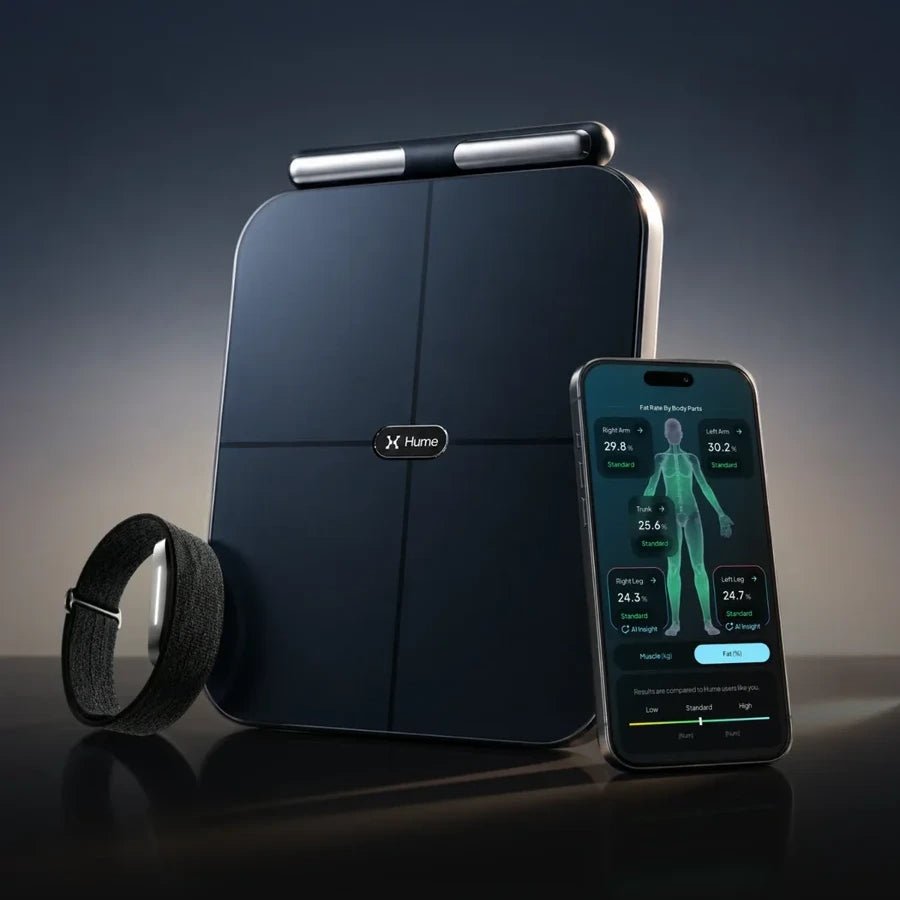
Hume Pod + Hume Band 2.0
For most readers who found this page by searching "hume vs oura", the deciding question is the subscription. If $5.99 a month for a well-studied ring feels fair, Oura is the safer pick on evidence. If it doesn't, Hume is a reasonable band at a fixed price, with scores you should read as trends rather than facts.
Our Hume Health brand page covers the company, and the current Hume offer is on the discount code page. To buy direct, go to Hume's Band page. Hume's 45-day trial means you can wear it through a few weeks of real nights before you decide.
- Choose Oura if published accuracy matters most to you, you swim or dive, or you want a CGM connected to the same app.
- Choose Hume if you won't pay a monthly fee, you lift or work with your hands, or you're between ring sizes.
- Choose Hume with the Pod scale if body composition is part of the plan; read how bioimpedance scales perform before you trust the segmental numbers.
- Choose neither if you need clinical readings. Both are trend tools, and a validated cuff still beats either for blood pressure.