What Hume Health actually sells
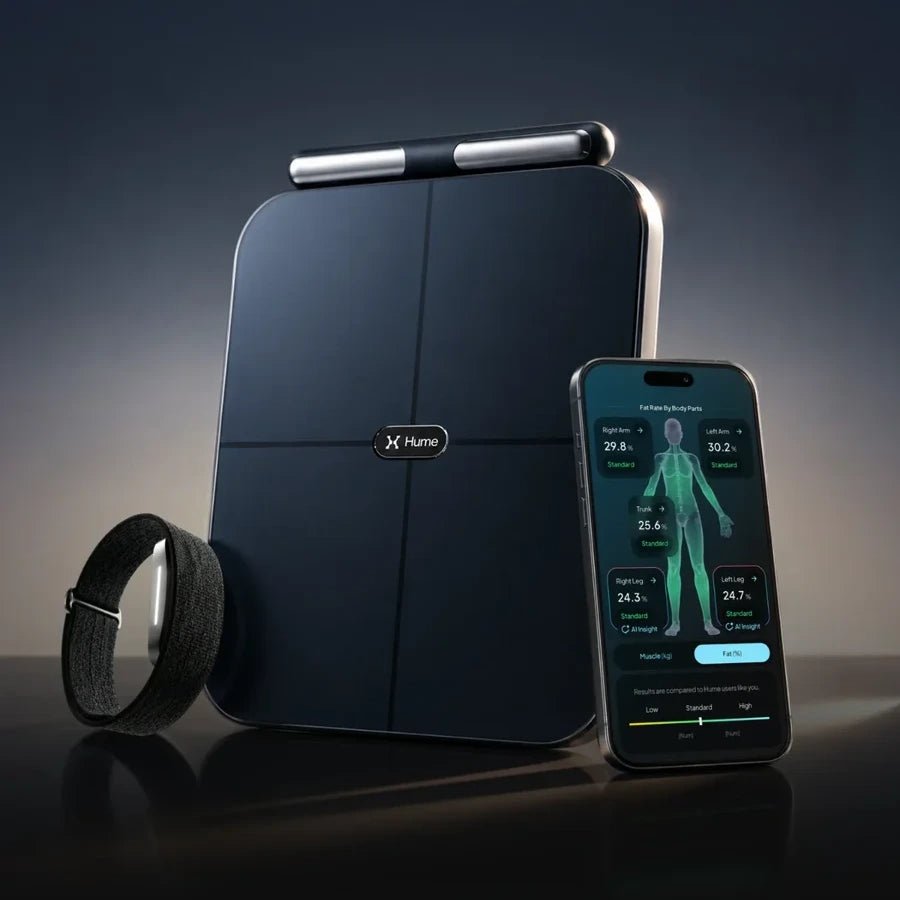
Hume Health is a health-technology company built around two flagship hardware products: the Hume Pod, a body-composition smart scale, and the Hume Band 2.0, a longevity-focused wearable. A combined Hume Pod + Hume Band 2.0 bundle and a HumeWeave 2.0 replacement strap accessory round out its core lineup, alongside a free companion coaching app.
The brand markets itself around "democratized healthcare," positioning its hardware as bringing clinical-style precision into a home setting, a framing worth examining critically given the real accuracy limitations of consumer-grade measurement technology, covered in depth in our companion piece on bioelectrical impedance scale accuracy.
The Hume Pod: what it measures
The Hume Pod uses 8-sensor bioelectrical impedance analysis (BIA) to estimate more than 45 metrics, including body fat percentage, muscle mass, visceral fat, metabolic age, hydration levels, and segmental body composition broken down by region. That sensor count and metric breadth is a genuine step up from a basic single-path bathroom scale.
The vendor states that 83% of Hume Pod users reach their weight goals in under six months. This is a marketed statistic from the vendor's own site; we did not see the underlying study design, sample size, or methodology behind it, and a self-reported user outcome figure from a brand's own marketing is a materially weaker claim than an independently run clinical trial.

The Hume Band 2.0: what it claims
The Hume Band 2.0 is a wearable focused on longevity-related biomarker tracking, paired with the same companion app. The vendor's most striking marketed claim is that Hume Band users gain an average of "2 years and 5 days of extra life" from the habit changes the device and app encourage.
We could not trace this specific, highly precise figure to a named study or public methodology on the vendor's homepage at the time of this review. A claim connecting a wearable's habit-tracking data directly to added lifespan, stated with this level of precision, warrants real skepticism until the underlying research is named and independently checkable.
What we verified and what we couldn't
We confirmed that the Hume Pod uses genuine 8-sensor BIA technology and tracks a genuinely broad set of metrics, a real technical feature rather than an exaggerated claim. Bioelectrical impedance itself is an established, widely used measurement technique; multi-sensor consumer devices are a legitimate product category, not a novel or unproven approach.
We could not independently test a Hume Pod unit against a clinical reference method like DEXA to confirm its specific accuracy, and we could not verify either the 83% goal-achievement statistic or the 2-years-5-days lifespan claim against a named, checkable study.
Pricing and what's included
Hume Health doesn't publish clear standalone pricing on its homepage for either the Pod or the Band at the time of this review; pricing appears at the product page level and varies with promotions and bundle options. The companion app is free and includes AI-guided coaching (branded "Pro.f") alongside data tracking and personalized habit recommendations, without a separate subscription fee layered on top of the hardware purchase.
That's worth noting as a genuine positive relative to some wearable categories, where an ongoing app subscription is common on top of the initial hardware cost.
| Product | What it measures/does | Format |
|---|---|---|
| Hume Pod | 45+ body composition metrics via 8-sensor BIA | Smart scale |
| Hume Band 2.0 | Longevity-related biomarker tracking | Wearable band |
| HumeWeave 2.0 | Replacement strap | Accessory |
Who this is and isn't for
The Hume Pod suits someone wanting more detail than a basic bathroom scale provides, particularly for tracking body composition trends over time under consistent conditions, as covered in our bioelectrical impedance accuracy guide. The Hume Band suits someone interested in habit-driven biomarker tracking, with the caveat that its most dramatic marketed claim isn't independently sourced on the vendor's own site.
Neither product is a clinical diagnostic tool, and this review describes what Hume Health sells and what we could verify, not a recommendation for or against either device. The same marketing-claim-versus-checkable-fact standard applies here as it does to reading a supplement label.