Why the label matters more than it should
Supplements are regulated in the US under the Dietary Supplement Health and Education Act (DSHEA). The practical effect: a supplement can be sold without the FDA verifying, in advance, that it contains what the label says or that it's safe at the stated dose.
The FDA's own page on dietary supplements confirms this directly. Manufacturers are responsible for ensuring their products are safe before marketing. The FDA generally only acts after a problem is reported.
That gap is exactly what third-party testing programs exist to fill. A supplement carrying a real certification mark has voluntarily paid for and passed an independent lab's verification.
A supplement with no mark simply hasn't. That doesn't automatically mean it's bad. It does mean nobody outside the company has checked.
The three certifications actually worth looking for
NSF Certified for Sport is the gold standard for anyone competing in a drug-tested sport, since it specifically screens for banned substances and contaminants in addition to verifying label accuracy. It's the mark most professional sports leagues and the US Olympic Committee point athletes toward.
USP Verified, from the US Pharmacopeia, confirms the product contains the ingredients and amounts on the label, is free of harmful contamination levels, and will actually break down and release into the body within the claimed timeframe. It's the mark you'll most often see on mainstream drugstore brands like Nature Made.
Informed Choice / Informed Sport is a UK-based program with similar goals to NSF Certified for Sport, common on protein powders and performance products, and widely trusted internationally.
A fourth option, ConsumerLab, isn't a manufacturer certification but an independent subscription testing service that buys products off the shelf and publishes results, including for brands that never sought certification themselves. It's a useful cross-check specifically because it isn't paid for by the brand being tested.
| Certification | What it verifies | Most common on |
|---|---|---|
| NSF Certified for Sport | Label accuracy + banned substance screening | Athletes, sports nutrition products |
| USP Verified | Label accuracy, contamination limits, dissolution | Mainstream drugstore brands |
| Informed Choice/Sport | Label accuracy + banned substance screening | Protein powders, performance products |
| ConsumerLab (independent) | Off-shelf testing, published publicly | Any category, brand doesn't pay for it |
"Third-party tested" without a mark is a marketing sentence
Here's the single most common label trick: a bottle that prints the phrase "third-party tested" somewhere in its marketing copy, with no actual certification logo, no named lab, and no way to look up the result. That sentence costs a copywriter nothing to write. It verifies nothing to a shopper.
A brand that genuinely paid for third-party testing almost always wants the logo prominently displayed. It's expensive, and they want credit for it.
The honest version of this claim names the certifying body, NSF, USP, Informed Choice, and displays the actual mark. See the phrase without the logo? Treat the claim as though it was never printed. BioLongevity Labs is a useful example of the other end of this spectrum, a public, searchable Certificate of Analysis for its full catalog, openly linked rather than merely claimed.

Reading the "other ingredients" list
The active ingredients get all the attention, but the "other ingredients" line below the supplement facts panel is worth a glance too, particularly for allergies and fillers. Common entries include cellulose (a plant-fiber capsule filler), magnesium stearate (a flow agent that keeps powder from clumping during manufacturing), and gelatin (animal-derived, relevant if you're vegetarian or vegan and looking for a plant-based capsule instead).
Magnesium stearate specifically has an online reputation as harmful that isn't well supported by the actual research; the amounts used are small and it's generally recognized as safe by the FDA. It's worth knowing what it is mainly so a scary-sounding ingredient name doesn't get mistaken for a real red flag when the actual issues (elemental weight, proprietary blends, unnamed labs) are elsewhere on the label.
Artificial colors and unnecessary added sugars in gummy formulations are a more legitimate thing to screen for if you're trying to minimize additives generally, though they're a preference question rather than a safety or efficacy one for most adults.
Why this all falls on the buyer
None of this is meant to suggest every supplement company is acting in bad faith. Plenty invest genuinely in testing and transparent labeling. The regulatory structure simply doesn't require it, which shifts the verification burden onto the shopper by default.
Learning to read a label properly is the closest substitute available for the pre-market review the FDA doesn't perform in this category, and it applies across every supplement guide on this site, not just this one.
Structure/function claims vs disease claims
Supplement labels are legally allowed to make "structure/function" claims, statements like "supports immune health" or "promotes healthy sleep", without FDA pre-approval. What they cannot legally claim, without extensive drug-level evidence, is that a product treats, cures or prevents a specific disease.
That's why labels use careful, vague language rather than direct medical claims, and it's also why that vague language shouldn't be mistaken for a verified health outcome. Every structure/function claim on a supplement label is required to carry the standard disclaimer that it hasn't been evaluated by the FDA, worth actually reading rather than skipping past as boilerplate.
What the "Supplement Facts" panel is legally required to show
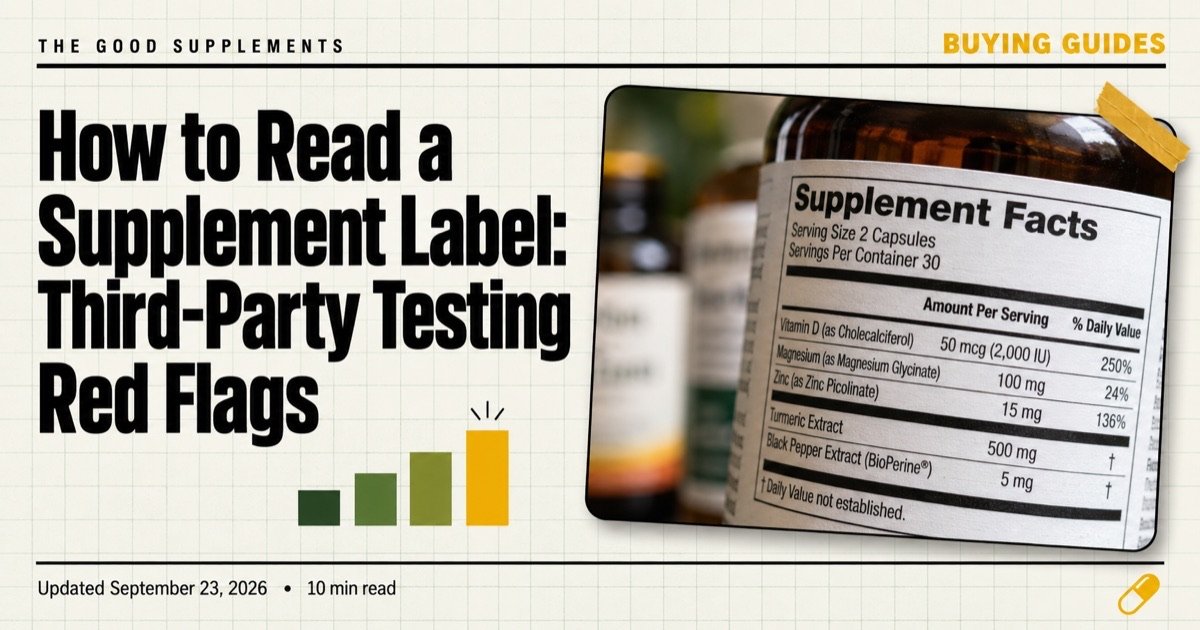
Unlike marketing claims, the Supplement Facts panel itself is a regulated format. It must list serving size, servings per container, and the amount of each dietary ingredient per serving.
For vitamins and minerals with an established Daily Value, it must show percent Daily Value too. This panel is the one part of the label that's actually standardized and enforceable, which is exactly why the elemental-vs-compound and per-ingredient breakdown questions above are worth checking there specifically, rather than trusting the front-of-package claims.

Other label tricks worth knowing
Proprietary blends list a combined total weight for several ingredients without breaking out how much of each one is actually in the product. That lets a formulator put a meaningful-sounding total on the front label while burying an under-dosed key ingredient behind cheaper fillers. No way for a shopper to know the actual per-ingredient split.
Compound weight vs elemental weight applies to minerals specifically: magnesium, calcium, zinc, iron. The compound weight, "magnesium glycinate 1000mg," overstates the actual usable mineral amount, sometimes by 85% or more. Covered in detail in the magnesium glycinate dosage guide; the same principle applies to most chelated mineral supplements.
Unnamed testing labs show up constantly in the peptide and research-chemical space. A vendor claiming "tested by three independent certified laboratories" without naming any of them is making an unverifiable claim. Sounds impressive. Gives a shopper nothing to actually check. This exact pattern is broken down in how to vet a peptide vendor.
- Look for an actual certification logo, not just the phrase "third-party tested"
- For mineral supplements, check elemental weight, not just compound weight
- Be skeptical of proprietary blends that hide individual ingredient amounts
- A named testing lab is checkable; an unnamed one is a marketing claim