

The short answer

Hume Health
Hume Pod
If you already own the original Body Pod and it reads reliably, the Pod 2.0 isn't a must-have. It measures the same way, through the same eight contact points, into the same app.
What Hume changed is the hardware that touches your skin and the electronics around it. Those changes target the two things owners complained about most: readings that drift as coated pads wear, and inconsistent contact. If that describes your scale, the 2.0 is a real fix. If it doesn't, you'd be paying $249 for a cleaner-looking version of what you have.
For a new buyer the question is simpler. The original sells for less on Hume's own landing pages, so it comes down to whether metal sensors and a contact check are worth roughly $66 to you.
One plain note before the detail: we haven't used either scale. This comparison is built from Hume's specs and pages, published research on impedance scales, and owner reports. We earn a commission if you buy through our Hume links.
Settling it: is the original Body Pod foot-only or 8-electrode?
This comes up a lot, so here is the evidence we checked on 18 November 2026. The original is an 8-electrode scale with a handle.
- Hume's original-Pod page lists "8 electrodes, hands + feet" and "8-point segmental BIA, handheld electrodes", and says the scale puts "a sensor on both hands and both feet".
- Hume's older Body Pod page says the sensors "embedded in the handle" scan the torso, arms and legs, and its FAQ tells you to hold the handles steady above waist height.
- The Amazon listing (B0DSY137KK), titled "The Body Pod", shows the scale with a corded handle and an app screen splitting fat percentage by left arm, right arm, trunk and each leg.
- Hume's own upgrade notice, written when it retired its older Dara scale in 2025, describes the Body Pod as "a major leap forward with an 8-sensor array" and "full body segmentation".
- Independent write-ups from 2025 and 2026 describe four electrodes in the platform and four in a retractable handle, and note it won't work with socks.
Where the foot-only idea probably comes from
Our best explanation is the company's history. Hume Health grew out of FitTrack, and the App Store listing for the Hume Health app is still published by FitTrack Inc. FitTrack's earlier scale, the Dara, had four foot electrodes and no handle, as Woman & Home's FitTrack review describes. Hume ended Dara support in 2025 and offered owners the Body Pod at 50% off.
So a reader who remembers a foot-only Hume or FitTrack scale is probably remembering the Dara. The Body Pod that replaced it has always had the handle.
A second source of confusion is Hume's own comparison chart, which labels a rival scale "Foot-only, 4 electrodes". That label sits in the Withings column, and it doesn't match Withings' handle-equipped Body Scan either, as our body composition scales guide points out.
What actually changed in the Pod 2.0
Hume describes the 2.0 as "rebuilt inside and out". Strip out the adjectives and four changes are left, all stated on the Pod 2.0 page.
- Solid metal sensors. Hume says coated sensors "can wear thin" and that the 2.0's metal base keeps contact consistent over years. The original's foot pads are coated electrodes on glass.
- A contact check before every reading. The scale confirms you're touching the sensors properly before it measures, which should cut down on the odd reading caused by a dry heel or a loose grip.
- Shielded electronics. Hume says the display, radio and sensors are isolated from each other so their electrical noise doesn't leak into the measurement.
- A new look. Sculpted sensors shaped to the feet, a display hidden until you step on, and two finishes: matte black with graphite sensors, or white with brushed steel.
Side by side
Read from Hume's product pages, FAQs and the Amazon listing on 18 November 2026. Where Hume's own pages disagree, we've said so in the cell.
| Original Body Pod | Pod 2.0 | |
|---|---|---|
| Electrodes | 8: four in the platform, four in a corded handle | 8: platform plus hand sensors |
| Segmental readings | Arms, trunk, legs | Arms, trunk, legs |
| Sensor surface | Coated pads on tempered glass | Solid metal, sculpted to the feet |
| Contact check | Not listed | Yes, before every reading |
| Electronics shielding | Not listed | Yes |
| Metrics claimed | 45 in the app | 45 in the app |
| Weight range | Up to 400 lb in the FAQ (spec sheet says 200 kg) | 11 to 441 lb (5 to 200 kg) |
| Display and battery | 2.8 inch display, rechargeable, up to a year per charge | Same figures on the spec sheet |
| Connection | Bluetooth, one phone at a time | Bluetooth, one phone at a time |
| Finishes | Black | Matte black or white |
| In Hume's store since | February 2024 | September 2026 |
Original Hume Body Pod vs Hume Pod 2.0
Metrics and the app: no difference you'd notice
Both scales feed the same Hume Health app and claim the same list: weight, body fat, muscle, visceral fat, body water, bone, metabolic age and the segmental split, plus heart rate from a sensor in the scale. Hume's pages describe the sensors as "8-frequency" in marketing copy and "dual-frequency" in the spec sheet, on both models, so treat the frequency claim loosely.
The subscription picture is identical too. Weighing in and seeing your body composition are free; Hume Plus is optional and adds coaching and a weekly report. Our guide to the Hume app, Hume Plus and Premium sets out exactly what sits behind the paywall and what it costs.
On accuracy, nothing published separates the two. Impedance scales track change over weeks far better than they nail a single morning, and the 2.0's improvements are about consistency, which is the property that matters for tracking. Our explainer on smart scale accuracy covers the research, and the Hume Pod review applies it to the 2.0.
Price: what each one costs today
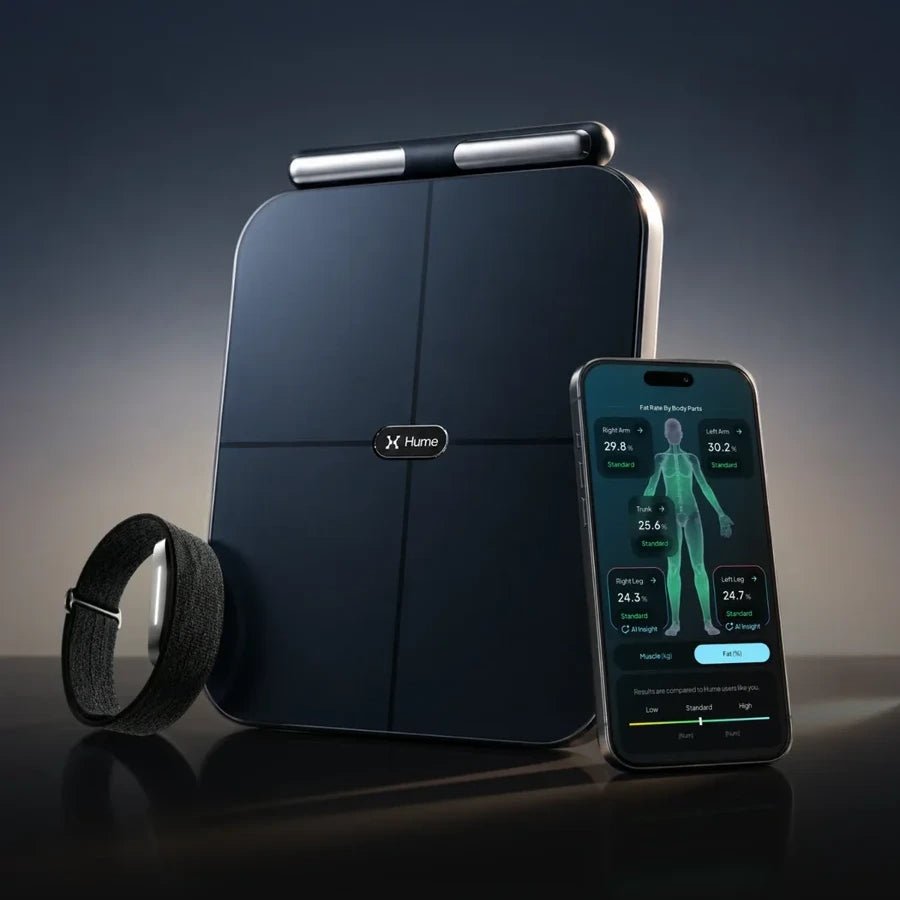
Hume Health
Hume Pod + Hume Band 2.0
Checked on Hume's US store on 18 November 2026. The original Pod is sold through two separate landing pages at two different prices, which is odd, so we list both.
| Item | Price | Shown against | Buy |
|---|---|---|---|
| Hume Pod 2.0 | $249 | $383 | Shop |
| Original Hume Pod (the-hume-pod page) | $183 | $352 | |
| Original Hume Body Pod (hume-body-pod page) | $229 | $366 | |
| Hume Pod + Band 2.0 bundle | $708 list | Bundle | Shop |
| 10-year warranty, added at checkout | $46 | $70 |
Hume Pod prices, checked 18 November 2026
Why the name changed, and what that means for search
Hume called its first handle scale the Body Pod. Its store now titles that product "The Hume Pod", the 2.0 is "The Hume Pod 2.0", and the Amazon listing still says "The Body Pod". Hume's own GLP-1 outcomes paper uses both names for the same device.
Search behaviour has followed the rename. Google Keyword Planner shows about 22,200 monthly searches for "hume body pod", down 55% on a year earlier, and about 14,800 for "hume pod", up more than tenfold. People searching the old name are usually looking at the original, often on Amazon; people searching the new one could mean either.
In practice: if a listing says Body Pod, it's the original. If it says Pod 2.0, it's the new one. A plain "Hume Pod" can be either, so check for the metal sensors and the 2.0 in the title before you pay.
Which one to buy
Buy the Pod 2.0 if you're starting fresh and plan to weigh in daily for years. Metal sensors that don't wear and a contact check are exactly what a trend instrument needs, and $249 is still cheap for a handle scale.
Buy the original if the lower price matters more and you'll treat it as a trend tool. It reads the same eight points. Keep the 45-day return window in mind if readings jump around.
Don't upgrade a working original unless its readings have become erratic. That's the specific problem the 2.0 was built to fix.
Hume's Black Friday countdown runs to 22 November, the day this post goes up, so the sale prices above may change from tomorrow.
Our Hume Health discount code page tracks the current offer, the Hume Health brand page has the full lineup, and our Hume Health review covers the Band as well. If you're weighing the Pod against a Withings scale instead, see Hume Pod vs Withings Body Scan.