
Why peptides get discussed for hair at all
Hair follicles are skin structures, and skin is where peptide evidence is strongest. That is the legitimate reason the question comes up rather than pure marketing drift.
The follicle cycles between growth, regression and rest, and the plausible intervention points involve signalling: extending the growth phase, improving the blood supply around the follicle, reducing inflammation at the scalp. Peptides are signalling molecules, so the fit is not absurd.
What follows from plausible is where this gets thin.
GHK-Cu, the one with a case
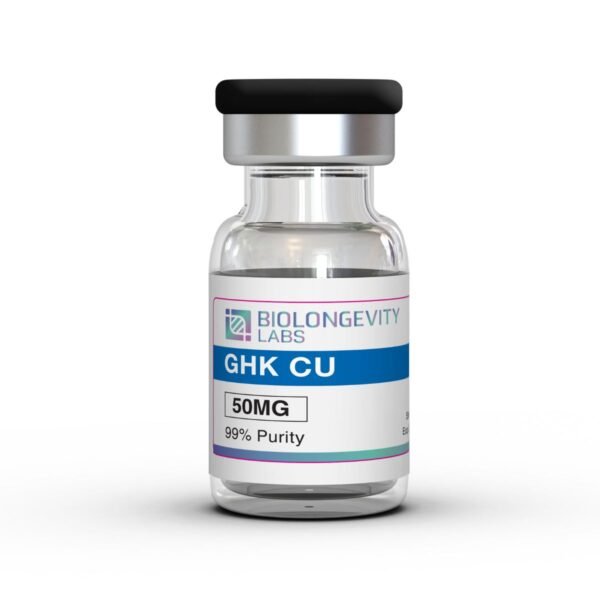
BioLongevity Labs
GHK-Cu Copper Peptide (50mg)
GHK-Cu is the copper tripeptide that carries the best evidence of any peptide we cover, mostly from skin and wound-healing research. Our peptides for skin page and copper peptides deep dive cover that work.
For hair specifically, the proposed mechanisms are follicle-level: stimulating dermal papilla cells, improving perifollicular blood supply, and reducing scalp inflammation. There is some published work on hair in connection with copper peptides, considerably less than the skin literature, and much of it formulation-sponsored.
Route matters here as much as anywhere. The hair work is topical, applied to the scalp. Vendors sell GHK-Cu as an injectable vial, and the topical scalp evidence does not transfer to subcutaneous injection elsewhere on the body.
Biotinoyl tripeptide-1
The other name that appears, almost entirely in cosmetic products rather than research catalogues.
It is marketed on follicle anchoring and growth-phase support, usually combined with other actives in a serum. The supporting data is largely from the ingredient manufacturer, and independent replication is sparse.
That is not an accusation, it is how most cosmetic ingredient evidence works. It does mean the confidence level should be lower than for a compound with independent trials.
The honest comparison
This is the part that matters most, and skipping it would make this page worse than useless.
| Intervention | Evidence | Route | Buy |
|---|---|---|---|
| Minoxidil | Decades of randomised trials, approved | Topical or oral | |
| Finasteride | Large randomised trials, approved | Oral | |
| GHK-Cu | Some published hair work, more formulation-sponsored than independent | Topical to scalp | Shop |
| Biotinoyl tripeptide-1 | Mostly manufacturer data | Topical cosmetic | |
| Injected peptides generally | No hair evidence | Subcutaneous |
Hair interventions by evidence quality
Why the photos are especially bad here
Hair cycles slowly. A follicle moving from rest into growth takes months to show as visible length, so any honest assessment of a hair intervention needs six months minimum.
That makes before-and-after photos in this category worse than usual, and they are already the weakest form of evidence. Lighting, hair length, wet versus dry, parting, and camera angle all change apparent density far more than six weeks of any treatment. Our before and after page goes through how to read them.
It also means anyone showing you a four-week hair transformation is showing you a photography result.
Where we land
If hair loss is the actual problem, the treatments with real evidence are the well-known ones, and a clinician is the right starting point for them. That is not a hedge, it is where the randomised trials are.
Topical GHK-Cu has a plausible mechanism and modest supporting work, and is reasonable as an adjunct rather than a replacement. Injecting GHK-Cu for hair has no evidence behind it at all.
Everything referenced from these vendors is sold for research use, and nothing on this page is medical advice.