

Where bioregulators came from
The bioregulator story starts in Soviet military medicine in the 1970s. Vladimir Khavinson, a military physician, and his colleague Vladimir Morozov began making peptide extracts from animal glands, starting with the calf thymus and the pineal gland, as a way to support immune and hormonal function. The first products were crude polypeptide mixtures, not single molecules.
Two of those extracts became drugs in Russia: Thymalin, from the thymus, and Epithalamin, from the pineal gland. Khavinson later founded the St. Petersburg Institute of Bioregulation and Gerontology, which has published most of the research since. His long 2002 review, Peptides and Ageing, describes three decades of that work and sets out what he calls the peptide theory of ageing.
The next step was the one that matters for today's market. The group analysed the amino acid makeup of each extract and designed tiny synthetic peptides to stand in for them: a dipeptide for the thymus, tetrapeptides for the heart, liver, brain cortex and pineal gland.
Epitalon (Ala-Glu-Asp-Gly) was designed as the synthetic counterpart of Epithalamin. Most of what vendors sell as "bioregulators" now are these synthetic short chains.
We couldn't find a primary source for every detail of the early military history that circulates online, so treat the colourful versions as the institute's own story rather than documented fact.
The claimed mechanism
The standard textbook view is that a peptide this short gets broken down quickly and acts, if at all, on a cell-surface receptor.
Khavinson's group argues something different. In their 2021 systematic review in Molecules, they propose that peptides of two to seven amino acids can pass into the nucleus, bind single- and double-stranded DNA and histone proteins, and change DNA methylation, which would let them turn genes on or off.
There's lab work behind each step. Their group has shown fluorescent-labelled short peptides entering the nucleus of HeLa cells and binding histones, and a 2023 docking study modelled how 26 of these peptides might enter cells through the LAT1, LAT2 and PEPT1 transporters. The last one is computer modelling rather than an experiment.
The tissue-specific part is the bold claim. The idea is that a cortex peptide acts on cortex cells and a vessel peptide on vessel cells, because each sequence matches binding sites in genes that tissue uses. It's an interesting hypothesis. It hasn't been tested by groups outside the school in any systematic way.
How strong the evidence is
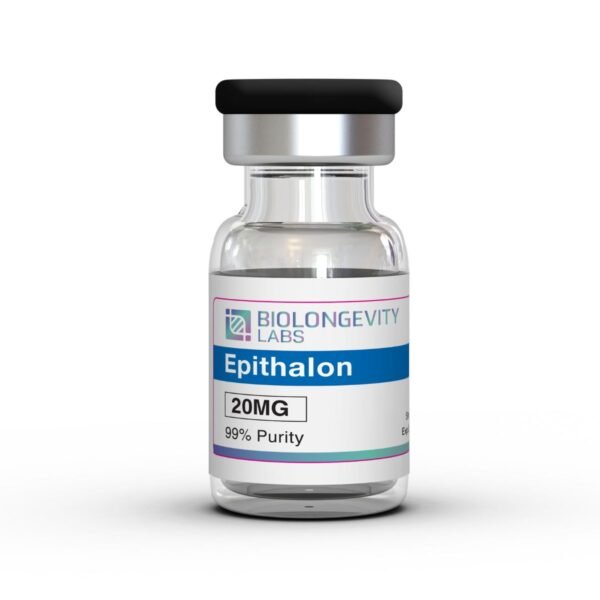
BioLongevity Labs
Epithalon (20mg)
We searched PubMed on 18 November 2026. Khavinson is an author on roughly 500 indexed papers.
Search results for each bioregulator range from nearly 300 for Thymalin and about 140 for Epitalon down to four for Testagen and nine for Pancragen. Two search terms mostly return something else: "Cardiogen" pulls up CardioGen-82, a rubidium generator for heart imaging, and "Ovagen" pulls up a veterinary fertility hormone.
Most of the work has four limits in common:
- It comes from one network. Nearly every paper lists the St. Petersburg institute or its long-term partners in Kiev and Tbilisi.
- Much of it appears in two journals, Bulletin of Experimental Biology and Medicine and the Russian-language Advances in Gerontology, often as short reports.
- The bulk is cell culture, tissue explants, rats, birds and fruit flies.
- The human studies that exist are small, and the abstracts rarely describe randomisation or blinding.
The human data and the outside replications
The most cited human result is a 2003 paper following 266 older people for six to eight years. It reports mortality falling 2.0 to 2.1-fold in the Thymalin group and 4.1-fold in a group given Thymalin plus Epithalamin every year.
Those are huge effects. The abstract doesn't describe how people were assigned to groups, and the result hasn't been repeated by an independent team. Big numbers from small, unblinded cohorts usually shrink when someone else tries.
Smaller human reports include Pancragen in 33 older adults with type 2 diabetes, a Kiev study with Khavinson as co-author, and Livagen in lymphocytes from older people, which is cells in a dish rather than a treatment.
Independent replications are rare, and Epitalon is where they exist. A 2025 study from Brunel University London found Epitalon lengthened telomeres in normal human cells through telomerase, matching Khavinson's 2003 report.
The same study found telomere lengthening in breast cancer cell lines through a different pathway, which is not a reassuring footnote for a longevity compound. Chinese labs have also used Epitalon on mouse oocytes in vitro. Our Epitalon guide covers that in detail.
For the rest of the family, we found no independent human trial at all.
The main bioregulators, sequences and prices
Sequences are as BioLongevity Labs lists them, cross-checked against PubMed where a paper names the sequence. Prices were read from biolongevitylabs.com on 18 November 2026. Where a product is marked down, the list price is in brackets. The "claimed target" column is the vendor and institute claim, not an established effect.
Khavinson bioregulators at BioLongevity Labs, checked 18 November 2026
What each one has been tested on
Limitless Biotech
Testagen (20mg, KEDG)
A short tour, with one representative paper each. All of these are from Khavinson's group or its partners unless we say otherwise.
- Thymalin: the 2003 cohort above, plus a 2020 study on human blood stem cells. A 2023 analysis found the dipeptides KE and EW inside the extract, which is the link to Vilon and Thymogen. We compare it with the better-studied thymus peptide in Thymalin vs Thymosin Alpha 1.
- Thymogen (Glu-Trp): an immunomodulatory dipeptide reported to slow ageing and spontaneous tumours in rats. Thymogen is used as a drug in Russia; the vial sold here is the synthetic research peptide.
- Vesugen (KED): vascular endothelial cells in culture, and a 2021 cell model of Alzheimer's disease.
- Cortagen (AEDP): sciatic nerve regeneration in rats.
- Cardiogen (AEDR): mostly appears in review papers, such as a 2022 review of cardiovascular cell ageing. We found little standalone experimental work under the name.
- Bronchogen: bronchial epithelium in rats with obstructive lung disease. One DNA study writes the sequence as Ala-Asp-Glu-Leu, while vendors list Ala-Glu-Asp-Leu. That's a real discrepancy worth knowing about.
- Pancragen (KEDW): the diabetes study above and a Russian-language study in old female rhesus monkeys.
- Pinealon (EDR): cell viability and free radicals and rat offspring after prenatal stress.
- Testagen (KEDG): the smallest record of the lot. Its best-known paper tests it on thymus morphology in birds, not on testes.
- Livagen (KEDA): chromatin in lymphocytes and enzymes that break down enkephalins.
- Ovagen (EDL): we found no PubMed paper that names it, so its liver claim rests on vendor copy. BioLongevity's own page cites renal cell work instead.
- Cartalax (AED): covered in our Cartalax guide, with the COA checked.
Where to buy, and what's on sale
Limitless Biotech
Livagen
BioLongevity Labs carries the widest range of synthetic bioregulators we've seen from a US vendor.
On 18 November 2026, nine were marked about 60% off on their product pages: Cortagen, Cardiogen, Bronchogen and Chonluten at $27.99, Ovagen, Testagen, Thymagen and Vilon at $31.99, and Pancragen at $37.99. Thymulin, a thymus peptide from outside the Khavinson family, was also down to $25.99.
Cardiogen, Bronchogen, Chonluten, Thymagen and Vilon showed as out of stock that day. Our BioLongevity sale page tracks what's still marked down.
For full-price items, ATLAS15 takes 15% off: Epithalon drops to $80.72, Vesugen to $72.22 and Livagen to $67.97. The store doesn't say whether the code stacks on sale prices, so check the cart line. BioLongevity also sells capsule "Bio" products built on organ extracts, such as BioThymus and BioVesugen. Those are a different product type from the synthetic vials in the table.
Limitless Biotech sells Testagen and Livagen as vials. Its prices stay hidden until a research account is approved, and Jiffy15 takes 15% off once you're in. One small flag: the Livagen page's synonym list includes chemical names for an unrelated bacterial cell-wall fragment, which looks like a database copy error. Our Limitless Biotech review covers the account process.
Whichever vendor you use, request the certificate of analysis for your own lot. Some of BioLongevity's published certificates have carried template errors, so check that the compound name and mass on the COA match the vial. Our BioLongevity Labs review and the guide to vetting a peptide vendor explain what to look for.
The research-use line
These synthetic peptides are sold for laboratory research only. Thymalin, Thymogen and a few extract products have Russian drug registrations, but none of the synthetic vials is approved by the FDA, and none can legally be sold as a dietary supplement in the US. We don't give personal dosing guidance.
Most of the published work used nanogram concentrations in cell culture or small doses in rats, which don't translate into a human amount. If you're handling the dry powder, the peptide storage guide explains why cold, dark and dry matters for short chains like these.