
Why nobody grows these peptides
Insulin and most big protein drugs are made by engineered cells. Short peptides like BPC-157 (15 amino acids) or TB-500 fragments are a different job. They're small enough to build chemically, one amino acid at a time, and chemistry is cheaper and faster at this size than fermentation.
That's why the term synthetic peptides covers nearly everything sold by research vendors. When BioLongevity Labs says on its quality standards page that its material comes from "solid-phase peptide synthesis in United States facilities", it's describing the standard industry method, not something proprietary. Checked 18 November 2026.
What separates one vendor's vial from another is how well each step was run, and how much of that the paperwork shows. If you're new to the category, our beginner's guide to research peptides covers the legal framing first.
Step 1: building the chain on a bead
Bruce Merrifield's 1963 paper in the Journal of the American Chemical Society introduced the idea that earned him a Nobel Prize: anchor the first amino acid to an insoluble resin bead, add the next one, wash away everything that didn't react, and repeat. Because the growing chain stays stuck to the bead, purification between steps is just rinsing.
Modern labs mostly use Fmoc chemistry. Each incoming amino acid has its reactive end capped with an Fmoc group, so it can only join the chain in one direction. A mild base strips the cap off, the next amino acid couples on, and the cycle repeats.
A 2016 review in the Journal of Peptide Science describes Fmoc SPPS as the method of choice for peptide synthesis today, and explains why: the conditions are gentler than the older Boc approach and it suits automated synthesizers.
Each coupling step is very efficient, but never perfect. If every step works 99% of the time, a 15-residue peptide like BPC-157 comes off the resin at roughly 86% full-length chains before any cleanup. Longer sequences lose more. That arithmetic explains most of what follows.
Step 2: cleavage, and what comes off with it
Once the sequence is complete, the chain is cut off the bead and the side-chain protecting groups are removed in one go, usually with concentrated trifluoroacetic acid (TFA) plus scavenger chemicals that mop up reactive fragments.
What you get is crude peptide: the target sequence mixed with everything that went slightly wrong. A review of related impurities in peptide medicines by D'Hondt and colleagues groups them into synthesis impurities, degradation products and impurities that form later in storage. For research buyers the synthesis group matters most:
- Deletion peptides, where one coupling failed and the chain carried on without that amino acid.
- Truncated sequences, which stopped growing partway and were capped or left short.
- Protecting-group adducts, where a cap that should have come off during cleavage stayed on.
- Racemised versions, where one amino acid flipped to its mirror-image form during synthesis.
Step 3: HPLC purification
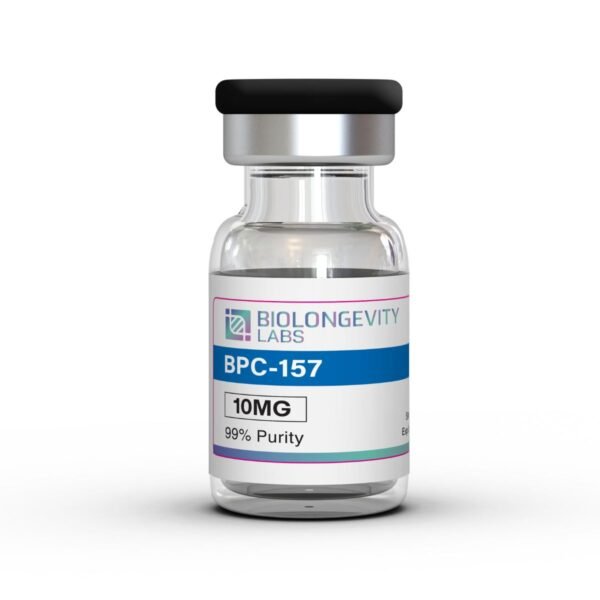
BioLongevity Labs
BPC-157 (10mg)
Crude peptide is cleaned up by preparative reversed-phase HPLC. The mixture is pushed through a column packed with oily silica, and molecules come out at slightly different times depending on how they interact with it. The lab collects the fractions that hold the target and discards the rest.
The hard part is that a deletion peptide missing one amino acid behaves almost like the real thing. Separating them takes a good column, a slow gradient and some judgement about which fractions to keep. Pool too generously and purity drops; pool strictly and yield drops, which costs money. That trade-off sits behind every purity number you'll see.
The mobile phase used for this step almost always contains a little TFA. That's where the TFA salt comes from: the positively charged parts of the peptide pair up with trifluoroacetate, and that pairing survives into the final powder unless someone pays for a salt exchange to acetate or hydrochloride.
BioLongevity's BPC-157 (10mg) was $99.97 when we checked the store on 18 November 2026, or $84.97 with ATLAS15. The price is set by this purification step more than by the raw amino acids.
Step 4: freeze-drying and filling
The purified fractions are mostly water and acetonitrile. To get a shelf-stable product, the solution is frozen and the solvent is pulled off under vacuum, a process called lyophilisation. BioLongevity's quality page describes the end of the line plainly: material is lyophilised into powder, filled into glass vials and sealed with a rubber stopper.
This is also the stage where a clean peptide can pick up contamination. Glassware, water and handling can introduce bacterial endotoxin, the fragments of bacterial cell walls that cause fever and inflammation when injected. Endotoxin is heat-stable and doesn't show up on HPLC. FDA's guidance on pyrogen and endotoxins testing sets out the standard assays, built on USP chapter 85.
Freeze-dried peptides keep well when stored correctly. Our peptide storage guide covers what happens after the vial reaches you.
What each step looks like on a COA
A certificate of analysis is a test report on finished material from one batch. It can't show you the synthesis, but some of the failures above leave fingerprints the tests can pick up. Here is what each common line on a peptide COA does and doesn't tell you.
| COA line | What it checks | What it misses |
|---|---|---|
| Purity by HPLC (%) | Share of UV signal in the main peak; catches most deletion and truncated sequences | Impurities that co-elute with the main peak; salts, water and endotoxin |
| Identity by mass spec | Molecular weight matches the intended sequence | How much of the impurity load is present; small mass shifts if resolution is low |
| Content or quantity (mg) | How much peptide is actually in the vial | Often absent; without it, a 10mg label is unverified |
| Endotoxin (EU/mg or EU/mL) | Bacterial endotoxin from filling and handling | Live bacteria; that needs a sterility test |
| Sterility | Microbial growth in the finished product | Endotoxin from dead bacteria |
| Counter-ion (TFA or acetate) | Which salt form you have and roughly how much | Rarely reported by research vendors at all |
Reading a peptide COA against the manufacturing steps
Worked example: BioLongevity's three labs
BioLongevity Labs names three outside testing labs on its quality page: SafeCert Labs, BioRegen and AV Analytics. According to that page, BioRegen reports identity, quantity and purity by UHPLC-MS, and AV Analytics reports identity, quantity, purity and endotoxin with a photo of the vial as received.
Purity specifications are set at 98% or 99% depending on the compound, and an endotoxin assay is listed for every batch. Checked 18 November 2026.
The page also gives a cross-check: one GLOW blend batch came back at 99.75% at one lab and 99.72% at BioRegen. Two labs agreeing to within 0.03 points is what you'd hope to see, and it's more useful than a single number. BioRegen certificates can be checked at bioregen.com/verify and AV Analytics certificates at avanalytical.com/coa-search; the page doesn't give a verification route for SafeCert.
Two cautions. The page lists purity testing as both UHPLC-MS and reversed-phase HPLC with UV detection in different tables, so it's worth checking which method your certificate actually used.
Some published certificates have template errors; we found an LL-37 COA labelled Cardiogen. If a certificate doesn't match the product in front of you, ask the vendor for the COA tied to your lot. Our step-by-step on verifying a BioLongevity Labs COA walks through it, and the BioLongevity Labs review has our wider verdict.
Worked example: Limitless and lot-level paperwork
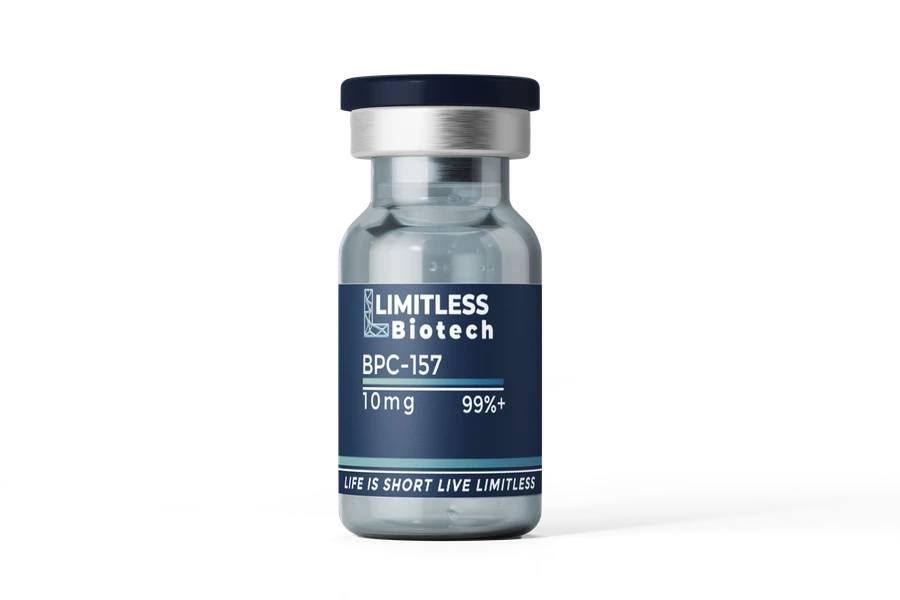
Limitless Biotech
BPC-157
Limitless Biotech takes a different approach. Its BPC-157 page lists eight lots, among them #1305, #1347 and #1342, each with three separate documents: purity, sterility and endotoxin. That's 24 files for one product, viewable without an account, checked 18 November 2026.
Separate sterility and endotoxin reports cover exactly the filling-stage risks that HPLC can't see, which is why we rate the practice well in our Limitless Biotech review. What the product page doesn't show is the testing lab's name or test dates, so you have to open each file to find them. Our upcoming guide to reading Limitless Biotech COAs does that lot by lot.
Limitless hides prices until your research account is approved. Code Jiffy15 takes 15% off once you're in, through Limitless's store; details are on the Limitless discount code page.
What to ask before you buy
None of this needs a chemistry degree. When you're comparing sellers, the manufacturing story above turns into a short set of questions. The full checklist is in how to vet a peptide vendor, and our roundup of where to buy research peptides applies it to named stores.
- Is there an HPLC chromatogram, or just a percentage? A trace lets you see whether there are shoulder peaks hiding near the main one.
- Does the mass spec result match the sequence's expected molecular weight?
- Is net peptide content in mg reported, or only purity?
- Is endotoxin tested on this batch, and is the limit printed next to the result?
- Does the batch number on the certificate match the one on your vial?
- Which lab ran it, and can you verify the certificate on that lab's own site?
Where this leaves you
Peptide production is a mature, well-documented process, and a competent lab can turn out 98% to 99% material reliably. The gap between vendors is mostly in purification discipline, contamination control at filling, and how honestly they publish the results.
A good COA answers three questions: is it the right molecule, how much of the vial is that molecule, and is it clean of endotoxin. Our ranking of the best peptide companies by their COAs scores vendors on exactly that. If you settle on BioLongevity, ATLAS15 takes 15% off, explained on the BioLongevity Labs discount code page.
Everything here concerns compounds sold for laboratory research only. Nothing in this article is dosing advice.