
Why subcutaneous rather than intramuscular
Nearly every research peptide protocol describes subcutaneous injection: into the fat layer just under the skin rather than into muscle.
The reasons are practical. The volumes involved are tiny, often under a tenth of a millilitre, which does not need muscle to absorb. Subcutaneous tissue gives slower, steadier uptake. And a short insulin needle into fat is far less uncomfortable and far harder to get wrong than an intramuscular injection.
This is also why the whole category standardised on U-100 insulin syringes, which our calculator is built around.
The sites people use
Four areas come up consistently in protocols, chosen for having a reliable fat layer and no major vessels or nerves near the surface.
- Abdomen, roughly two inches either side of the navel. The most commonly described site, with the most consistent fat layer.
- Outer thigh, the upper outer quarter.
- Upper outer arm, the back of the arm. Harder to reach on yourself.
- Upper outer buttock. Same reach problem.
Where things actually go wrong
BioLongevity Labs
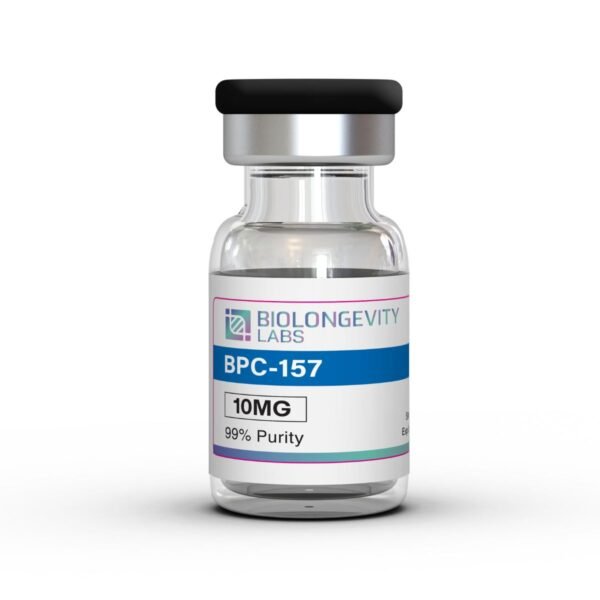
BPC-157 (10mg)
Across every compound we have written about, injection-site reactions are the single most reported complaint. Redness, a small lump, soreness, occasional bruising.
The useful thing about that is how much of it is avoidable, because the common causes are procedural rather than pharmacological.
| Problem | Usual cause |
|---|---|
| Lumps at one site | Repeat injections in the same spot without rotating |
| Stinging on injection | Cold solution straight from the fridge, or injecting too fast |
| Bruising | Hitting a small vessel, or pressing hard after withdrawing |
| Redness and warmth spreading | Possible infection. This one is a clinician's problem, not a forum's |
| Blunt, painful entry | Reusing a needle. They dull after a single use |
Common problems and what causes them
The sterility steps that matter
In rough order of how much difference each makes.
- A fresh needle every time. Needles are single-use and dull immediately, which is what makes a reused one hurt.
- Swab the vial stopper before every draw, not just the first.
- Swab the skin and let it dry. Injecting through wet alcohol is what causes a lot of the stinging people blame on the compound.
- Never share a vial between people. Bacteriostatic water limits microbial growth, it does not make a vial safe to share.
- Watch the expiry on the reconstituted vial. Our storage guide covers the two-to-four-week window and why freezing a reconstituted vial is a bad idea.
On very small volumes
A practical point that affects accuracy more than anything else on this page. Many peptide doses land at a handful of units, and some land at four or five, which is right at the edge of what a syringe barrel can be read to.
The fix is reconstituting with more bacteriostatic water. It does not change the dose, it spreads the same dose over more of the barrel. A 5mg vial in 2ml puts a 100mcg dose at 4 units; the same vial in 5ml puts it at 10 units, which is far easier to measure.
Our calculator lets you compare water volumes before committing, and the reconstitution guide walks through the mechanics.
What technique cannot fix
Perfect sterile technique does nothing about what is in the vial. If the product carries endotoxin, or is not what the label claims, no amount of swabbing helps.
That is why we grade vendors on documentation rather than on presentation. Our vendor vetting guide covers what a certificate should show, and sterility and endotoxin are the two tests most often missing.
Everything referenced here is sold for research use only. This page describes what circulating protocols say, it is not instruction, and anyone injecting anything is better served by a clinician than a website.