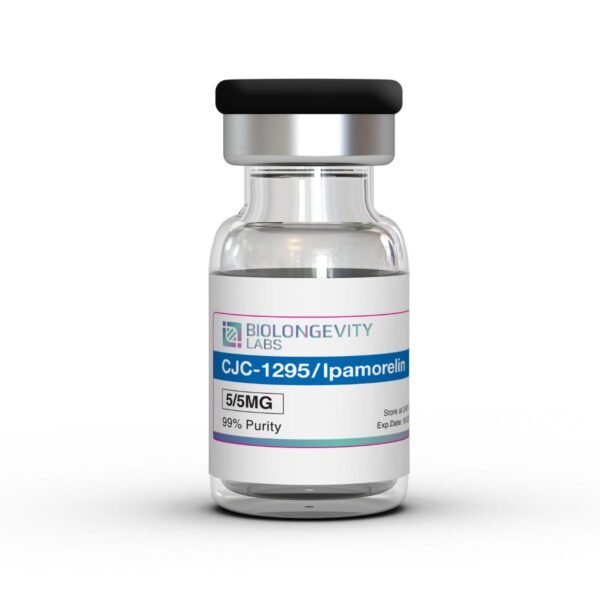

What's in the vial
BioLongevity Labs sells the blend as Tesamorelin and Ipamorelin (Blend) (8mg). Each vial holds 6mg of tesamorelin and 2mg of ipamorelin as freeze-dried powder, a fixed 3:1 ratio by mass. The listed price on 18 November 2026 was $115.00, in stock, and the product page says it ships the same business day for orders placed before noon Pacific.
The two peptides push on the same output, growth hormone release from the pituitary, through two different receptors. Tesamorelin mimics GHRH, the hypothalamic hormone that tells the pituitary to release growth hormone. Ipamorelin binds the ghrelin receptor, also called the growth hormone secretagogue receptor, which triggers release by a separate route.
That pairing logic isn't new. It is the same idea behind the better-known CJC-1295 and ipamorelin blend, which we cover in our peptide dosing hub. What's different here is that the GHRH half is a molecule with an FDA label, which makes it unusually easy to check what is known about it.
Everything below describes published research. Both compounds are sold by BioLongevity strictly for research use, and nothing here is guidance on using either one.
Tesamorelin: the half with an FDA label
Tesamorelin is a 44-amino-acid analogue of human GHRH with a trans-3-hexenoyl group added to the front end, a change that slows its breakdown. The current Egrifta WR label on DailyMed gives the indication as reduction of excess abdominal fat in HIV-infected adults with lipodystrophy, and lists initial US approval as 2010.
The label is just as specific about what the drug isn't for. It says tesamorelin is not indicated for weight loss because it has a weight-neutral effect, and that long-term cardiovascular safety hasn't been established. It is contraindicated in active malignancy, pregnancy and disrupted pituitary function. Its warnings cover raised IGF-1, fluid retention, glucose intolerance and hypersensitivity reactions.
The trial behind the approval is solid by peptide standards. In the 2007 NEJM phase 3 study, 412 people with HIV and abdominal fat took tesamorelin or placebo for 26 weeks. Visceral fat measured by CT fell 15.2% on tesamorelin and rose 5.0% on placebo, and IGF-1 rose 81%. A pooled analysis of two phase 3 trials followed in 2010.
A later randomised trial in Lancet HIV looked at fatty liver in 61 people with HIV. After 12 months, liver fat fell by an absolute 4.1 percentage points more than placebo, a 37% relative drop. That is the most interesting newer result, and it is still a small trial in one population.
None of this research used a research-grade vial. The trials used the pharmaceutical product made under drug manufacturing rules, which is the thing a research vial isn't.
Ipamorelin: the half that never got approved
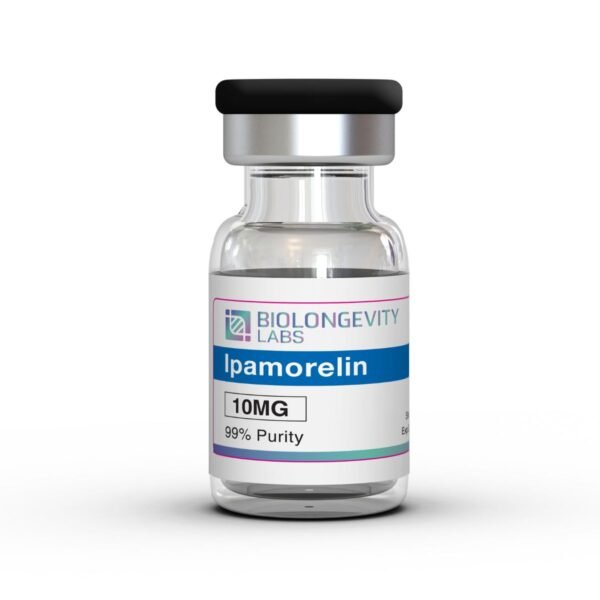
BioLongevity Labs
Ipamorelin (10mg)
Ipamorelin is a five-residue peptide that Novo Nordisk developed in the 1990s. The 1998 paper describing it called it the first selective growth hormone secretagogue. In rats and pigs it released growth hormone about as strongly as the older GHRP-6, without the rise in ACTH and cortisol that GHRP-6 and GHRP-2 produced, even at doses 200 times higher.
That selectivity is why it became popular. The human record is thin, though.
The one published patient trial, a phase 2 study in 114 bowel-surgery patients, gave intravenous ipamorelin or placebo after the operation to speed gut recovery. Median time to a first tolerated meal was 25.3 hours against 32.6 hours, and the difference wasn't significant (p = 0.15). The authors reported it was well tolerated and found no efficacy difference.
So ipamorelin's reputation rests on animal pharmacology and one human trial in a setting unrelated to body composition. It has no approved use in the US or elsewhere.
BioLongevity sells it alone as Ipamorelin (10mg) at $79.97, checked 18 November 2026. The ipamorelin share of the blend, 2mg, is a fifth of that vial.
Why pair them, and what research exists for the pair
The case for combining a GHRH analogue with a ghrelin-receptor agonist comes from older physiology work. In a 1990 study in 18 healthy men, Bowers and colleagues gave the hexapeptide GHRP with GHRH and found the two together released growth hormone synergistically, more than either one predicted. Their reading was that the two act through independent mechanisms.
That study used GHRP-6 and native GHRH, not ipamorelin and tesamorelin. It supports the general idea and says nothing direct about this blend, its ratio, or how the two behave mixed in one vial.
For the specific combination, we found nothing. A PubMed search for tesamorelin and ipamorelin on 18 November 2026 returned seven papers, and every one is a review, mostly about peptides in sports medicine and self-administration. There is no trial, no pharmacokinetic study and no stability study of the two together.
If you see a claim that the stack "works better" or has "clinical backing", ask which study. On what we could find, the honest answer is that each half has its own record and the pair has none.
Blend vs separate vials: the price
BioLongevity sells all three as separate listings. Prices below were read from the store on 18 November 2026, with ATLAS15 applied at 15% off.
| Product | Contents | Listed | With ATLAS15 | Per mg (listed) | Buy |
|---|---|---|---|---|---|
| Tesamorelin and Ipamorelin Blend | 6mg + 2mg | $115.00 | $97.75 | $14.38 | Shop |
| Tesamorelin | 10mg | $149.97 | $127.47 | $15.00 | Shop |
| Ipamorelin | 10mg | $79.97 | $67.97 | $8.00 | Shop |
| Tesamorelin + Ipamorelin, bought separately | 10mg + 10mg | $229.94 | $195.45 | $11.50 | |
| CJC-1295 (no DAC) + Ipamorelin Blend | 10mg | $99.97 | $84.97 | $10.00 | Shop |
BioLongevity Labs prices, checked 18 November 2026
Reading those numbers
Priced at the single-vial rates, the contents of one blend vial (6mg of tesamorelin at $15.00 a milligram plus 2mg of ipamorelin at $8.00) would come to about $106. So the blend costs roughly $9 more than the same milligrams bought loose. The catch is that you can't buy them loose: getting there means buying both full vials for $229.94.
The blend is cheaper upfront. The separate vials give you more total material and let a protocol set its own ratio, where the blend fixes it at 3:1. Which one is better value depends entirely on what the research design needs, which is why we won't pick one for you.
Free shipping starts at $400, and quantity discounts apply on multiple units, so add up the basket before applying the ATLAS15 code. Our BioLongevity price list has the rest of the catalogue.
Dosing tables and per-protocol cost belong in a separate piece. Our tesamorelin dosage chart and cost post covers published trial protocols and what they cost per week at these prices.
What the certificate shows
The product page links its latest certificate, labelled Tesamorelin/Ipamorelin (261478). We opened it on 18 November 2026. It was issued by MDx BioAnalytical Laboratory for batch 29-3-46150, received 4 May 2026 and reported 18 May 2026.
- Labelled quantity 6/2mg; determined content 6.09mg and 1.99mg.
- Purity 99.76%, with both peptides identified by liquid chromatography and mass spectrometry.
- Endotoxin: pass, against a threshold of 0.05 EU/mL or lower.
- A search code (261574) for looking the certificate up on the lab's own site, plus a photo of the tested vial.
Two caveats on the paperwork
MDx isn't one of the three labs named on BioLongevity's quality standards page, which lists SafeCert, BioRegen and AV Analytics. That isn't a problem in itself, and the MDx certificate is checkable through its search code. It does mean the testing lab varies by product, so read the lab name on each certificate rather than assuming.
The certificate also describes one batch tested in May. Before you order, ask for the certificate matching the batch number on your vial. A few of BioLongevity's published certificates have had template errors, and our BioLongevity COA verification guide walks through matching a certificate to a vial. Our wider vendor vetting checklist applies to any seller.
Storage matters for a two-peptide powder. The product page says to keep it at minus 20°C sealed and away from light, then refrigerate after reconstitution. Our peptide storage guide explains why freeze-thaw cycles degrade peptides.
If you're comparing vendors
Limitless Biotech
Ipamorelin (5mg and 10mg)
Limitless Biotech doesn't list tesamorelin: its site search returned no results for it on 18 November 2026. It does sell Ipamorelin (5mg and 10mg), Sermorelin and CJC-1295 without DAC, so a GHRH-plus-ghrelin-receptor pairing is possible there with a different GHRH analogue. Prices are hidden until your account is approved, and the code Jiffy15 takes 15% off at Limitless Biotech.
Sermorelin and CJC-1295 aren't interchangeable with tesamorelin. Sermorelin is the first 29 amino acids of GHRH, and CJC-1295 is a modified version of that fragment; tesamorelin is the full 44 with a stabilising group, and it's the only one of the three sold today as an FDA-approved drug. Our full BioLongevity Labs review and comparison with Limitless cover the two vendors side by side.